
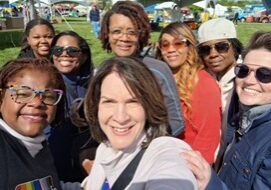
The NJEA Consortium is built on a “collective commitment to cultivating community, action, justice, and understanding within New Jersey’s public schools”. The very title of the three-year NEA grant that funds the program is “Cultivating Community, Action, Justice, and Understanding through the NJEA Consortium: Connections. Community. Curriculum,” which underscores the core importance of community to its identity and work.
External community engagement is equally critical to the Consortium’s mission. The goal is to build strong relationships beyond school walls and ensure that New Jersey’s diverse population sees itself reflected in the curriculum. This is accomplished by:
- Fostering Meaningful Conversations: The Consortium works to “foster meaningful community conversations that will prepare all stakeholders to understand, embrace and celebrate New Jersey’s diversity”.
- Building Partnerships: A stated objective is to “engage and amplify stakeholder voices through community-based discussions and projects”. This helps to identify local allies and leaders, enhancing awareness and collaboration.
- Creating Understanding and Empathy: Ultimately, the community engagement events and partnerships are designed to create the conditions for “deeper understanding, empathy and social justice in every school community”.
Recently, with the support of the NJEA Professional Development and Instructional Issues Division personnel, the NJEA Consortium has engaged in several community events to help further its mission. Here are some examples of the ways in which the NJEA Consortium has engaged with the community.
Teaching Asian American History in K-12 Classrooms
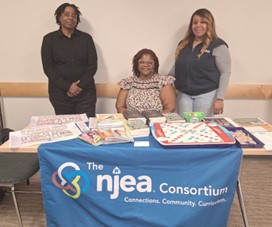
Seabrook Farms, a significant yet often overlooked chapter of New Jersey history. Kimeisha Boyd and Felicia Davis represented the NJEA Professional Development and Instructional Issues (PDII) Division and hosted a Consortium information table and AAPI-focused book giveaway. Dr. Kim Pinckney and Dr. Kani Ilangovan represented The E Pluribus Unum Project Inc. (TEPUP) Board and addressed the attendees to share about how the work of the Consortium and TEPUP both support pluralistic education and ensuring that students in our schools both see themselves within the curriculum as well as develop and appreciation for others’ experiences.
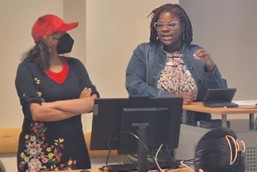
This event directly supports the NJEA Consortium’s mission by actively promoting culturally responsive and historically accurate education. By co-sponsoring a workshop on teaching Asian American history, the Consortium ensures that educators are equipped to integrate diverse perspectives into their curriculum. This initiative fundamentally contributes to ensuring all students see themselves reflected in their learning and develop an appreciation for others’ experiences, ultimately fostering a more pluralistic and inclusive educational environment across New Jersey.
NJ PRIDE Festival

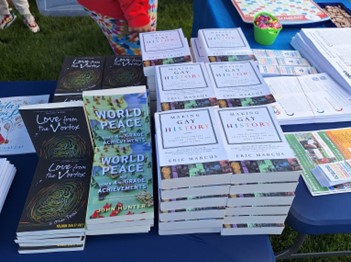
New Jersey’s 33rd Annual Statewide LGBTQ+ Pride Celebration was held on Sunday, June 1 2025 in Asbury Park. With overwhelming support from PDII Division staff and leadership, the Consortium hosted an information booth complete with an LGBTQIA+ inclusive and diverse book giveaway within the Pride Festival space. We joined other community groups and businesses to celebrate and uplift the LGBTQIA+ community, including our members and students.
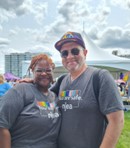
The NJEA Consortium’s support for the New Jersey LGBTQ+ Pride Celebration was vital because it directly aligns with their commitment to fostering inclusive and diverse educational communities. By hosting an information booth and distributing LGBTQIA+ inclusive books, the Consortium actively demonstrated its dedication to uplifting its members and students from the LGBTQIA+ community, reinforcing the importance of equity, acceptance, and cultural responsiveness within New Jersey’s educational landscape.
All In for Inclusive Education Summer Inclusive Leadership Conference
All in for Inclusive Education is one of the NJEA Consortium’s official partners in large part due to our mutual alignment and commitment where it comes to inclusive education. On June 6, All In hosted their Summer Inclusion Leadership Conference for administrators, educators, parents, and self-advocates—all about inclusive education. The NJEA Consortium co-sponsored this event, which boasted a variety of workshops giving attendees the skills and resources they need to develop and sustain inclusive learning communities—for all students.
In addition to providing an information table, Dr. Kim Pinckney and PDII colleague Camy Kobylinski co-lead a workshop entitled, “Windows, Mirrors, and Sliding Doors: Reflecting Disability, Opening Possibilities in K-12 Education.” This engaging workshop utilizes Dr. Rudine Sims Bishop’s powerful metaphor of windows, mirrors, and sliding doors to examine the critical role of representing people with disabilities in creating an inclusive K-12 ecosystem. Moving beyond compliance and tokenistic inclusion, we explored the profound impact of showcasing the diverse contributions, lived experiences, and perspectives of individuals with disabilities across the curriculum and school culture.
Inclusive Commitment Statements
At the conclusion of the workshop, participants were invited to craft their own inclusive commitment statements. Their statements are powerful because they demonstrate a genuine shift from passive understanding to active engagement, personal responsibility, and concrete action. Here are some examples the participants submitted:
- I commit to bringing neurodivergent authors and characters to my English classrooms
- I commit to further develop curriculum and introduce resources that allow ALL of my students to experience mirrors interwoven into the curriculum.
- I commit to caring more about the windows and doors, not just for my children’s disabilities but for all. I will bring this to our school’s DEI Committee.
- I commit to prioritize changing the norm in our districts and creating an inclusive environment across all settings!
Each statement is specific and action oriented. They also reflect intentional application demonstrating how they internalized the framework to apply it directly to their roles and organizational contexts. These statements further highlight a broadened perspective: The shift from personal connection (“my children’s disabilities”) to a universal commitment (“for all”) showcases empathy and a wider understanding of the need for disability visibility and inclusion across the entire student body and school environment. Finally, they exemplify the Consortium’s mission to affect systemic change.
Workshop Impact
The workshop was very well attended and received, as evidenced by the following program evaluation data:
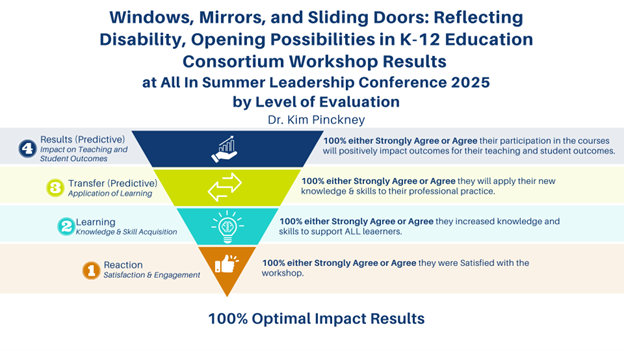
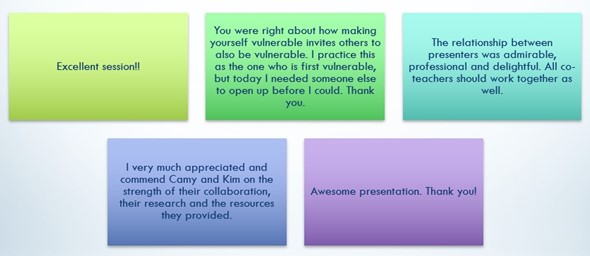
Not only was the quantitative data favorable across four levels of evaluation, but the participants’ comments also exemplified their take-aways from the workshop. Here are some of the participants’ comments:
Conclusion
We know that the work of the Consortium takes each and every one of us. This is why we focus on community engagement to help spread awareness, empower educators, and to help move the needle towards more intentional inclusion. With sincerest gratitude, I thank the Professional Development and Instructional Issues Division for their unwavering support as we work to achieve the goals of the NJEA Consortium.
Be on the lookout for more sightings of the NJEA Consortium in the Community!