
by Carolyn Thompson, NJEA PDII staff
The World Peace Game is a hands-on political simulation that gives players the opportunity to explore the connectedness of the global community through the lens of economic, social, and environmental crises and the imminent threat of war. The goal of the game is to extricate each country from dangerous circumstances and achieve global prosperity with the least amount of military intervention. As “nation teams,” students gain greater understanding of the critical impact of information and how it’s used. (Summarized from the WPG Foundation website.)
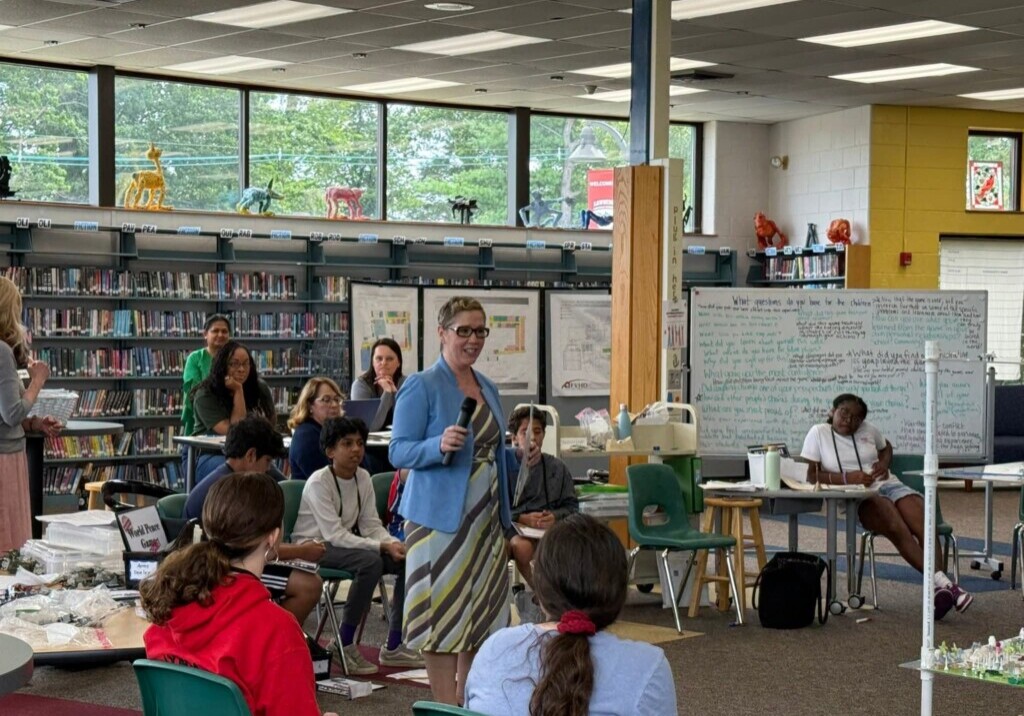
This past July, the students from Lawrence Intermediate School have gone home after a long week, the teachers have said their tearful goodbyes but are eagerly strategizing both in thought and on paper about how they will implement this game among their own students and beyond their own classrooms. The multi-tiered geo-political game board with its imaginative pieces are carefully wrapped and placed into a box waiting for the day they’ll be revealed once again to the next group of curious children somewhere in another place, in another school building, maybe even on another continent. The goal of achieving peace has been achieved; the ceremonious bell has been rung, and the third and final year of the World Peace Games has now come to an end.
The library tables and chairs are put back into place, a wonderous space with books lining the shelves that wrap around the crescent-shaped room, an abundance of light shining through the clerestory-style windows illuminating the sculptures placed carefully along the windowsill up high. This once-quiet space is where the work of the visionaries, the strategists, the integrators and the implementors allowed for this group of rising sixth graders to move through complexities and somehow find their way together through an experience, the true impact of which may not be fully realized until much later in their lives.
This room is now quiet again and I wondered, what did I just witness?
It takes a village:
- John Hunter, visionary, game creator and life-long teacher;
- The World Peace Game staff as they facilitate and guide the teachers in the training, being that beacon of light for the students to navigate and make their own choices on the next move;
- The National Education Association and their belief in Dr. Christine Miles, her vision of integrating this game into one piece of the larger puzzle that would become the NJEA Consortium, an NEA grant with the purpose of developing shareable, peer-reviewed, inclusive curricular resources for marginalized communities;
- My fellow NJEA colleagues, led by Dr. Kim Pinckney, Consortium Coordinator, who have implemented this vision into what we simply and often refer to as “the work” but truly something bigger, the effects of which will ripple through educators’ careers and through classrooms for years to come;
- The local leadership of the Lawrence Township Education Association, Michele D’Angelo, president and James M. Sharp, 1st vice president and their commitment to the success of this event, a relationship so valuable and one that has only strengthened through this experience together;
- The Lawrence Township Public Schools Administration, building principals and staff from all levels, from the first year to the third and final, joyfully delivering any supports needed and being the perfect host;
- The parents and guardians who made sure the students arrived every day, adhering to a strict schedule while juggling work and summer activities, a challenge they gladly took on, evidenced by their palpable gratitude as they shook our hands and walked out of the middle school with their children in tow;
- NJEA Leadership, including current President Steve Beatty, Vice President Petal Robertson, Executive Director Kevin Kelleher , and Deputy Executive Director Denise Graff Policastro who have been steadfast in their commitment and has shown up all three years to support this endeavor given its innovative educational approach for members and students alike;
- The teachers , our NJEA members, continually taking part in their personal and professional growth even after their students were dismissed back in June for the summer vacation. I fantasize about how they will manifest what they’ve learned from this training in their classrooms and beyond.
The World Peace Game has brought out sides of students that may not have been seen before-quiet kids suddenly finding their voice, natural leaders learning the power of listening, and the whole groups rallying together to solve big challenges like hunger or war. Back in the classroom, those same students are showing up differently; eager to collaborate, more patient with one another, and proud of what they can accomplish together.
This is the village that I’m honored to be apart, for me, what I view as a once in a lifetime experience.
I addressed the students before they left Friday afternoon, acknowledging their accomplishment of achieving the goal of the game and their commitment to show up every day. I intentionally named each partnership, hoping that this would be one of many “click” moments for them throughout the game when they recognize how many people truly care about them and their success. In conclusion I made a request, confident that I had consensus from the adults in the room without consultation, “Please take what you’ve learned this week, the relationships you’ve developed, the experiences you’ve had, the lessons you’ve learned and make this world a better place for all of us. We are counting on you!”