
Transforming mandated curricula into accessible, equity-centered performance tasks
When New Jersey introduced legislative mandates requiring public schools to weave diverse histories—including the Amistad Law, Holocaust and genocide studies, LGBTQIA+ and Disability rights, Diversity and Inclusion, and AAPI contributions—into K–12 classrooms, educators faced a distinct challenge: turning legal requirements into meaningful classroom experiences. Most pre-service programs simply have not prepared teachers to address these mandates across disciplines or through trauma-informed approaches.
At UDL-Con 2026, Dr. Kim Pinckney presented a session titled “Universal Design for Learning in Action: Transforming Mandated Curricula into Accessible, Equity-Centered Performance Tasks”. The session highlighted how the NJEA Consortium bridges the mandate-method gap by bringing three pedagogical frameworks together to build “born-accessible” learning environments.
“All of the mandates… are not merely requirements; they are a moral imperative. These mandates provide the essential framework for fostering a socially conscious and just society.”
— Dr. Kim Pinckney
The Three-Framework Paradigm Shift
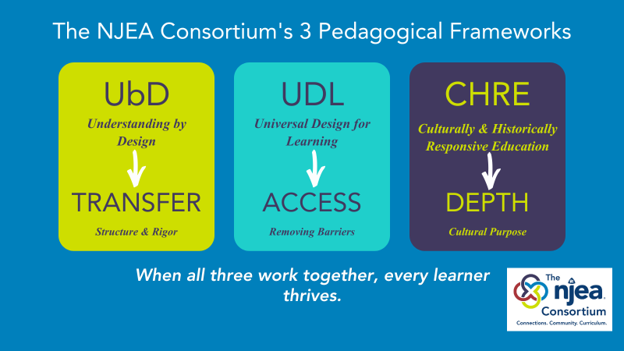
Rather than treating pedagogical models as isolated initiatives, the NJEA Consortium intentionally integrates three frameworks into a cohesive engine for systemic change:
- Understanding by Design (UbD): Provides structure and rigor through backwards design and the GRASPS model (Goal, Role, Audience, Situation, Performance/Product, Standards) to keep learning focused on transfer.
- Culturally & Historically Responsive Education (CHRE): Embeds Dr. Gholdy Muhammad’s five pursuits—Identity, Skills, Intellect, Criticality, and Joy—giving learning cultural purpose and depth.
- Universal Design for Learning (UDL): Leverages CAST 3.0 guidelines across Engagement, Representation, and Action & Expression to remove barriers and build learner agency.
By grounding design in learner personas (such as “Mateo,” a visual learner needing support with expressive communication) rather than static checklists or stereotypes, educators shift from individual retrofitting to proactive, equity-driven systems change.
Hands-On Learning: The “Inclusion Kingdom” Task
During a Virtual Design Lab facilitated alongside Design Team Ambassador Erin Putman, participants analyzed a sample 3rd–5th grade performance task titled “Inclusion Kingdom: Addressing Ableism through Policy and Institutional Change”.
In this unit, elementary students act as “student policy advisors” investigating institutional structures and addressing real-world issues like lunch segregation and harmful puzzle piece iconography.
- Identity & Criticality: Students reflect on language and critique who historically holds policy-making power.
- Skills & Intellect: Students organize interview data into simple charts and study the evolution of inclusion vs. historical asylums.
- Joy: The unit culminates in a “Neurodiversity Celebration” showcasing the art, beauty, and contributions of the disabled community.
Real-World Impact on Educator Practice
The NJEA Consortium’s Design Team Ambassadors (DTAs)—general educators co-creating units in micro-design teams—report transformative shifts in their classrooms:
- Shifting from Reactive to Proactive: Moving away from post-production fixes toward foundational accessibility. As elementary educator Tamar L.O. noted, the focus shifts “from fixing the student, to fixing the curriculum.”
- Equity over Equality: Moving beyond “giving every student the same thing” to “giving students what they need to thrive.” (America S., Multilingual Learner Educator)
- Cultivating Student Agency: Providing multiple pathways for expression allows students’ self-advocacy skills to grow exponentially.
Explore Consortium Resources
To minimize prep burden for teachers, published performance tasks are fully realized ~30-page guides featuring media links, citations, rubrics, and accommodation summaries.
- Access Curricula: Explore open-access performance tasks tagged by level (Elementary, Middle, High School) on the NJEA Consortium Hub.
- Read the Research: Learn more about the methodology in Dr. Pinckney’s open-source article, “Designing for Deep Learning and Inclusivity,” published in TechTrends.