
How my TAAS K-5 Residency aligns with my work as an NJEA Consortium Design Team Ambassador
by Tamar LaSure-Owens
There are moments in an educator’s career when you realize you are exactly where you are supposed to be, doing the exact work you were meant to do. As an NJEA Consortium Design Team Ambassador (DTA), my mission is to champion inclusive, intersectional education across New Jersey, moving our schools far beyond standard “heroes and holidays” tokenism.
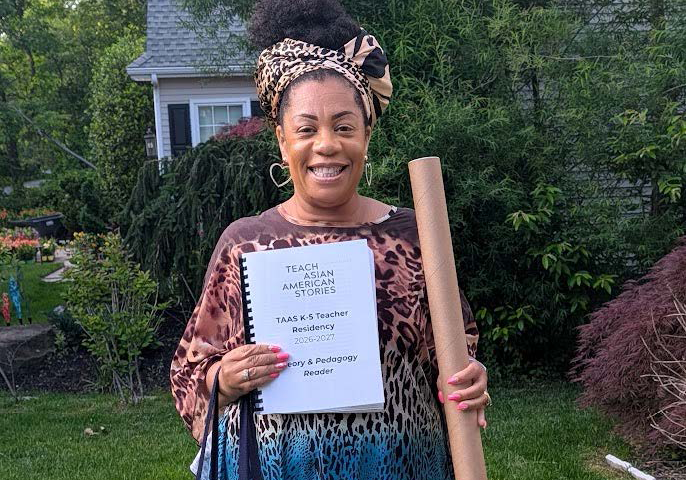
Recently, I received some incredible news that allows me to push this advocacy even further: I have been selected as one of an elite cohort of just eight educators to participate in the Teach Asian American Stories (TAAS) K-5 Teacher Residency pilot program. Representing South Jersey in this 13-month residency is an incredible honor, but more importantly, it is a seamless extension of my role as a Consortium DTA. On Tuesday, June 2, our cohort of eight gathered for a full professional day of learning. The energy in the room was electric—defined by high impact, deep engagement and rich professional collaboration. As we rolled up our sleeves, it became immediately clear how perfectly the TAAS residency aligns with the NJEA Consortium framework I am already modeling and advocating for as an Ambassador.
Grounding AAPI History in the Consortium Framework
The NJEA Consortium, heavily supported by the National Education Association (NEA), has established a revolutionary Macro-Curriculum. We use Grant Wiggins and Jay McTighe’s Understanding by Design (UbD) principles paired with Culturally and Historically Responsive Education (CHRE) to weave mandated histories—such as Amistad, Asian American Pacific Islander (AAPI), Holocaust, LGBTQIA+ and Disabilities, Hispanic and Latino, Native American and Indigenous—into the everyday instructional practices of K-12 classrooms.
Through the TAAS K-5 Residency, I am taking a deep dive into New Jersey’s Asian American and Pacific Islander (AAPI) mandate. This residency allows me to use my Design Team Ambassador lens to expand our scope, deepen our collective knowledge, and ensure AAPI histories are fully and seamlessly integrated into the Consortium’s three core thematic pillars:
- Identity & Self
- Institutions & Structures
- Activisms & Advocacy
Elevating Dr. Gholdy Muhammad’s 5 Pursuits
As a Design Team Ambassador, my work is fundamentally rooted in Dr. Gholdy Muhammad’s historically responsive literacy framework. The TAAS residency beautifully mirrors this approach. Under the brilliant guidance of Dr. Karishma Desai (Rutgers Graduate School of Education), Isabella Kasegrande and Sulynn Miao, our cohort is designing K-5 curricular interventions that intentionally hit all 5 Pursuits: Identity, Skills, Intellect, Criticality, and Joy.
“To teach human beings, we must understand who they are, but we must also understand who we are.” — Dr. Gholdy Muhammad
Choosing Joy: Modeling the Beauty of AAPI Histories
Of all the pursuits, the one that resonates most deeply with me right now is Joy. I am absolutely, completely joyous about this initiative! For too long, professional development in education has felt clinical or standard-driven. But on June 2, joy was our compass. Dr. Muhammad defines joy as wellness, beauty and justice. I felt that beauty in the room as we shared our visions, and I feel that wellness knowing that the work ahead will directly benefit my own classroom, Leeds Avenue Elementary School and Pleasantville Public Schools.
True equity work isn’t just about examining historical hardships; it is about uplifting the brilliant contributions, humanity, culture and triumphs of the AAPI community. As a Design Team Ambassador, I see it as my responsibility to not just write lesson plans, but to model to my colleagues the pure joy in teaching AAPI histories. When we lead with passion and celebration rather than just obligation, we transform how students interact with the material. They deserve to see themselves and their peers reflected beautifully in their learning, and they deserve an education that sparks their own internal joy.
The Blueprint of the TAAS Residency
This pilot program is a rigorous, 13-month commitment designed to create high-impact, classroom-ready interventions by May 2027. Over the course of the residency, I will be balancing:
- Collaborative Sessions: Attending 6 comprehensive in-person gatherings and 8-10 virtual meetings, staying stationary and fully engaged alongside my seven cohort colleagues.
- Mentorship & Research: Participating in monthly individual mentor calls starting in October 2026, alongside monthly academic readings and assignments to deeply understand AAPI pedagogies.
- Classroom Resources: TAAS is beautifully supporting this work by providing a $3,000 stipend, a specialized Foundational Library, and a Classroom Grant that will allow me to bring these high-quality, culturally rich materials directly to my students immediately.
We have full digital access to the workshop materials and slide decks created by Dr. Desai, Isabella Kasegrande and Sulynn Miao, maintaining high standards of intellectual property and professional attribution as we build out our units.
The Impact Ahead
TAAS is an initiative fueled by AAPI New Jersey, Incorporated. (a registered 501(c)3 nonprofi t), working to support public school students across all 600 NJ districts. Because our goals are entirely aligned with the NJEA Consortium, TAAS will be sharing our names, likenesses and the high-quality curriculum models we create to benefit educators statewide. As an NJEA Consortium Design Team Ambassador, I know that our state’s mandates are strongest when they are woven together, not treated as separate silos. The intensive learning on June 2 was the spark. I am incredibly eager to do the heavy lifting over the next 13 months, bridging my Ambassador training with specialized AAPI pedagogy, to create a classroom environment where every single one of my students can see themselves, find their voice and experience true educational joy.