
South Jersey Underground Railroad history comes alive in Triumphant Third Grade
by Tamar LaSure-Owens
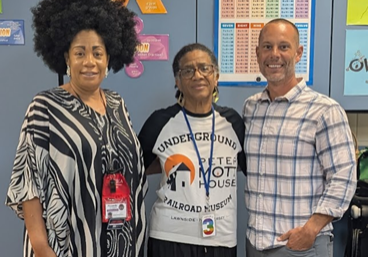
On Thursday, Sept. 25, my Triumphant Third Graders had the honor of welcoming Linda Shockley, President of the Lawnside Historical Society, to bring the story of the Peter Mott House and South Jersey’s role in the Underground Railroad to life.
This visit was part of our month-long study of What Was the Underground Railroad? by Yona Zeldis McDonough, a text featured on the Pleasantville Board of Education–approved 2025–26 Book & Presenters List for Triumphant Third Grade. Throughout September, International Underground Railroad Month, my students wrote daily historical facts about the Underground Railroad in New Jersey and strengthened their map-reading skills as we uncovered the nation’s first civil rights movement, which stretched south to Mexico and north to Canada.
Students prepared, engaged and leading the dialogue
When Ms. Shockley entered our classroom, she witnessed something rare—third graders already steeped in Underground Railroad history during the very first weeks of school. They were eager to share facts they had learned, including that Lawnside was originally called Snow Hill. I kept the dialogue moving by firing off quick questions, prompting students to showcase their knowledge. The excitement was palpable, and Ms. Shockley was able to see firsthand just how much elementary students can engage with complex history when given the opportunity.
Students lit up when sharing with Ms. Shockley that Harriet Tubman lived and worked in Cape May, a fact they proudly discovered during the first week of September. We also discussed Tubman’s famous words: “I never ran my train off the track and I never lost a passenger.” These words resonated deeply, and students clapped with joy when they heard stories of freedom seekers succeeding against all odds. They were particularly moved when they learned how William Still reunited with his long-lost brother, proof of the triumphs within the struggle. They also imagined the struggles and dangers of walking for miles, often for hours or days. In our dialogue we connected history to the present-how bounty hunters who pursued freedom seekers across state lines mirror the way ICE operates today.
The power of primary and secondary sources
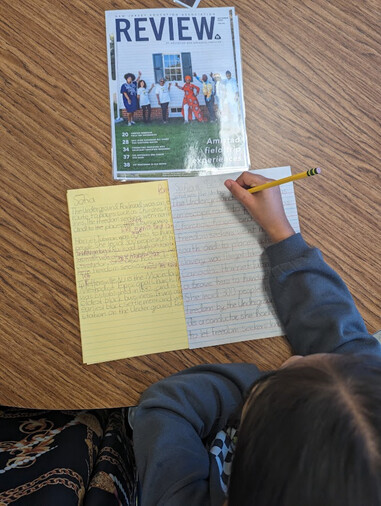
The October 2023 NJEA Review cover story on the Peter Mott House, which I was honored to contribute to, provided an additional lens of authenticity. My students saw that their teacher was part of the ongoing work to preserve and teach this history. They also learned the difference between primary and secondary sources: primary sources being firsthand accounts or objects from the time—like Still’s records and Tubman’s words—and secondary sources being the books and articles written later to interpret those events. We connected this to their own lives, discussing how family traditions, oral histories, and stories passed down are also valuable sources of history. Students realized that they, too, are keepers of history in their homes and communities.
Project-based learning across subjects
The Underground Railroad unit naturally lent itself to project-based learning. I challenged my students to use their Chromebooks to virtually “travel” to four different safehouses across New Jersey, calculating time of day, distance walked, and number of passengers. This integrated both math skills (addition and subtraction) and social studies content, showing that the Underground Railroad can be meaningfully taught across multiple disciplines, including English Language Arts and mathematics.
Connection to the Amistad Law, Diversity and Inclusion Law, and Consortium Macro-Curriculum
This lesson exemplifies New Jersey’s Amistad Law, which requires African American history to be integrated across all content areas, not treated as an “add-on.” By engaging with the Underground Railroad through primary and secondary sources, map skills, and interdisciplinary projects, students see themselves as active learners of state, national, and global history.
It also aligns with the Diversity and Inclusion Law, ensuring that instruction reflects the identities, experiences, and contributions of historically underrepresented groups. By connecting students to Harriet Tubman, William Still, and the communities of Lawnside and Cape May, the lesson models inclusion while fostering empathy and civic responsibility.
Below is a summary of alignment with the NJEA Consortium Macro-Curriculum:
Framework – Connection in Lesson
Themes – Freedom, Resistance, Identity, Community
Essential Questions (EQs)
What does it mean to seek freedom? How do communities work together for justice? How does history help us understand the present?
Enduring Understandings (EUs)
Resistance movements like the UGRR demonstrate how ordinary people shape extraordinary change. History is both local and global, rooted in community action.
Amistad Law
Underground Railroad instruction integrates African American history across disciplines, fulfilling New Jersey’s mandate for representative and inclusive curriculum.
Diversity and Inclusion Law
Promotes representation of diverse voices and lived experiences; connects Underground Railroad history to broader conversations about identity, belonging, and justice in New Jersey and beyond.
Five Pursuits (Dr. Gholdy Muhammad)
Identity: Students connected to Harriet Tubman, William Still, and their own New Jersey roots.
Skills: Practiced map reading, sequencing, addition/subtraction, reading comprehension, and Social Emotional Learning (SEL) through collaboration and empathy.
Intellect: Gained historical knowledge of Lawnside, Cape May, and safehouses.
Criticality: Discussed parallels between bounty hunters and ICE.
Joy: Clapped, celebrated, and engaged in dialogue with a historian.
Why it matters
By the end of the morning, my students didn’t just study history—they lived it. They imagined the struggles of walking miles for days, they analyzed maps of safehouses across New Jersey, and they celebrated the triumphs of ordinary people who resisted extraordinary odds. This is South Jersey history. This is New Jersey history. And it is history that my third graders will not forget.
Call to action
As educators, we must root our teaching in local stories and tangible history. When students see themselves, their communities, and their state reflected in learning, they don’t just collect facts—they build pride, empathy, and critical awareness. By weaving together mandated curriculum, primary sources, and community partnerships, we offer students not only knowledge but also identity, criticality, and joy. This is the work that ensures history is not forgotten but continuously learned, lived, and carried forward. Bringing local history into the classroom allows us to pass on the enduring lessons of freedom.